In today’s fast-paced world, businesses often find themselves caught in a never-ending cycle of trying to balance growth and productivity. Although both are crucial for success, they frequently seem to conflict with one another.
Growth
Growth refers to the process of expanding your business, such as increasing revenue, expanding your customer base, or launching new products or services. Growth is often seen as a positive measure.
Productivity
Productivity, on the other hand, refers to the efficiency with which companies achieve their goals. Productivity is about getting more done in less time, and with fewer resources. Productivity is the gold standard when analyzing economic growth. Productivity is also what will keep a company competitive.
Is it not what we all want? work less and gain more. Working smarter and not harder.
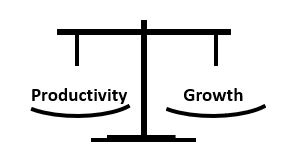
While growth and productivity are both important, they can often seem to be at odds with each other. For example, if you’re focused on growth, you may be more inclined to take risks and invest in new projects that may not be immediately profitable. This can be counterproductive, if it leads to a drain on resources and a decline in productivity.
On the other hand, if you’re focused solely on productivity, you may become too focused on optimization and efficiency and miss on innovation and growth opportunities. This can lead to a lack of progress and stagnation, as you may be hesitant to take risks or try new things.
Few examples:
A classic example of great productivity improvement was the industrial revolution in the 19th century. The agriculture and transport sectors have been transformed with machines. Farms did not need as many people as they did before to produce the same amount of food (or more) freeing up a large part of the workforce.
If you think of this period, it s easy to understand that even growing farms will fail if they did not adopt new technologies and productivity gain.
Another example,
Company A has 100 workers and generates 10m profit. The following year, profit is 15m, so a growth of 50% however the companies has now 200 workers. Which means that the company A has grown but is less efficient and less productive than the previous year. Company A is getting fatter, no economy of scale was gained and that’s often the traps of fast growing companies.
Now we have company B, which has started with 100 workers, but now only require 80 thanks to new technologies. Profit has improved by 1m, so a 11m profit for the year.
Which company would you invest in?
| # | Company A | Company B |
|---|---|---|
| Workers | 200 | 80 |
| Profit | 15m | 11m |
| Ratio Profit/worker | 75k / worker | 137.5k / worker |
Measurements
Growth is much easier to measure than productivity.
Even if the formula is quite easy Productivity = Output / Input
And that’s probably why most companies have KPIs linked to growth and not productivity. Machine efficiency ratio (eg OEE) does not tell the story about the state of productivity of a company. It’s possible to have a very well running machine 98% OEE but not very productive compare to another machine, requiring too much labour and energy).
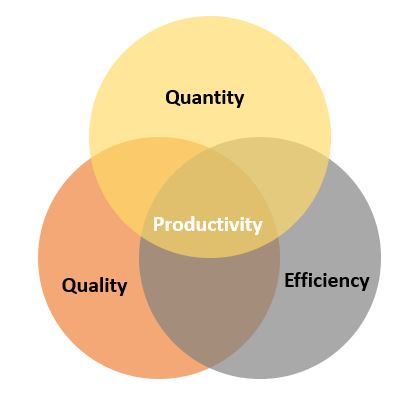
Productivity could be achieve in different:
– Reducing input (Efficiency),
– Increasing outputs (Quantity)
– Increasing Quality
Few ideas for measurement:
Revenue per Employee / cost of workforce per Quantity of products / number of tickets per hours /
Key questions which could help you in the quest for improve productivity:
- Can you achieve the same output but with reduced hours ?
- Can you achieve more output with the number of hours ?
- Can you change or improve your processes to reach higher quality with the same number of worker/hours ?
- Can you lower your input (electricity, gas, materials) and achieve the same outputs?
Balance Growth and Productivity
So, how can you find a balance between growth and productivity?
- Prioritize your goals: Take the time to identify your most important goals, and prioritize them accordingly. This will help you focus your efforts on the areas that are most important to your success.
- Focus on efficiency: Look for ways to optimize your processes and workflows to increase productivity. This could include automation, outsourcing, or other strategies that allow you to get more done with less.
- Embrace risk: While it’s important to be efficient, don’t be afraid to take risks and try new things. Innovation is a key driver of growth, and taking calculated risks can help you stay ahead of the competition.
- Stay flexible: Be prepared to adapt your strategies and goals as needed. The business landscape is constantly changing, and you need to be able to pivot quickly to stay ahead.
In conclusion, growth and productivity are both essential to achieving success. By prioritizing goals, focusing on efficiency, embracing risk, and staying flexible, you can achieve long lasting success.
If you want to know more about measurement on productivity, read this great paper:
https://hbr.org/1988/01/no-nonsense-guide-to-measuring-productivity